Last night we hosted a room of founders, marketing leaders, and partners we’ve worked with for years. Some of them, we’ve been building marketing for more than a decade.

Halfway through the evening, something happened that I’m still thinking about.
The conversations we were having were about agents, about which models run where, about how an ICP becomes something a system can actually read. These were not the conversations we were having with the same people a year ago. Not even six months ago. Same room. Same relationships. Completely different vocabulary.
That was the moment I understood why we’d called the evening in the first place. We weren’t introducing a new service. We were introducing a different Forabilis.

For most of 2025, the three of us, me, Shani, and Natan, kept coming back to the same question. Not what new tool to add. Not which agent to deploy. The question underneath all of that:
What is our service supposed to be in this world?
Because here’s what we kept seeing. The best marketing teams in the market, five, maybe ten percent, weren’t adding AI. They were rebuilding. Smaller teams. More senior people. The lines between Marketing, Sales, and RevOps almost gone. Shared context. Agents running against one operational ICP. Metrics that cut across functions. A new kind of marketing operating system.
Everyone else? Adding AI on top of what was already there.
The gap between those two groups is widening. Fast.
And we couldn’t keep doing the same work, just faster with AI underneath, without becoming exactly what we’re telling our clients not to be.
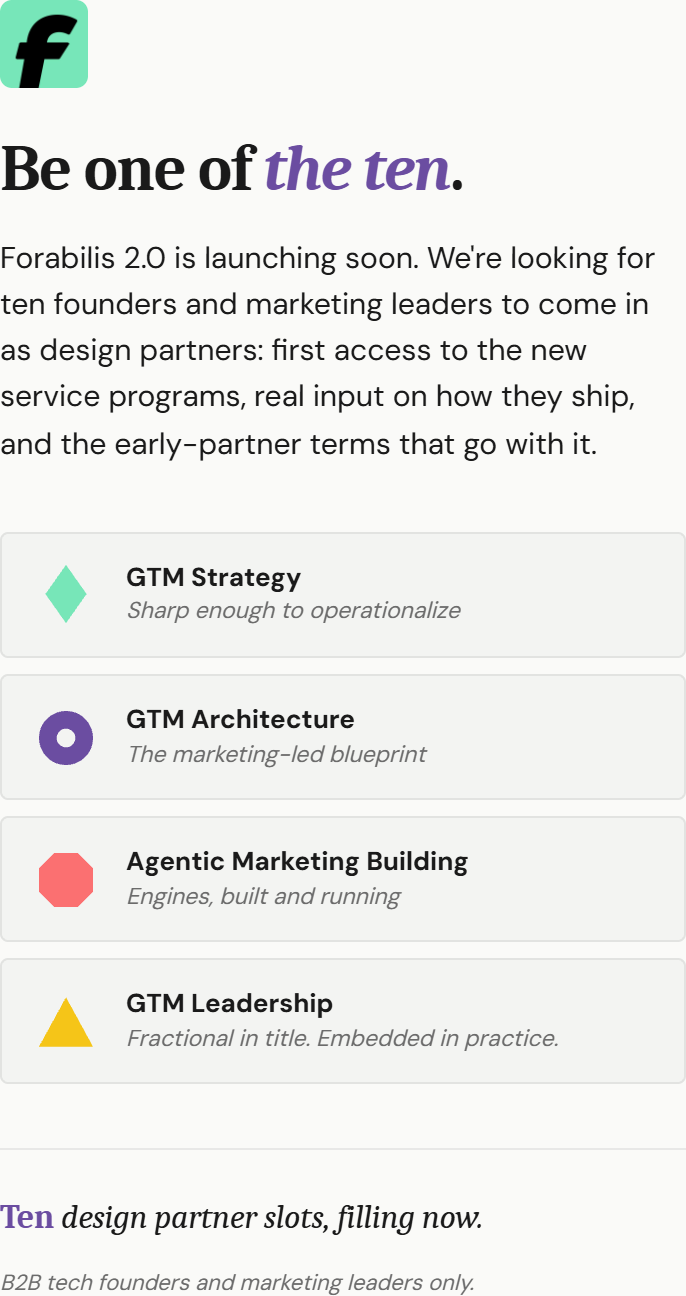
So we rebuilt Forabilis around four practices.
GTM Strategy. What we’ve always done well. Positioning, messaging, ICP, product story. What changed is the delivery. Strategy can’t live in a slide anymore. It has to break down into the signals and metrics that define an ICP, and into a system that actively enforces the messaging across teams. A 2026 positioning is operational, not descriptive.
GTM Architecture. The next-gen marketing plans. Not just which channels run, but which agents, where, and how many. Where AI runs, where humans stay in the loop, where AI shouldn’t run at all. This is the layer almost no one is building, and without it, every tool you bought doesn’t add up to one motion.
Agentic Marketing Building. Where the architecture becomes a marketing engine that actually runs. Agents in production. Workflows embedded. A system that lives.
GTM Leadership. We haven’t stopped embedding ourselves inside our clients’ teams. What changed is that we’ve learned to identify exactly when each form of leadership is needed, and it looks different at every client. PMM. Ops. CMO. Field.
Out of these four practices, the ones in the middle are where the real battle is today.
We’re good at building architecture for the same reason we’ve been good at building marketing engines all these years. We match it to client maturity, business needs, and budget. Not to whatever’s in fashion. The work isn’t only about execution. It’s about which model fits which stage. How workflows get embedded. How they stay flexible enough to evolve with the technology underneath them.
This is why we shifted. We’re no longer only a group of marketers. We’re also a house of Solution Architects. Shani leads it for product marketing. Sharon leads it for demand gen. They design agentic processes that fit the specific marketing motion each client actually needs, not the one a vendor is trying to sell them.
And the picture is different at every client. The agents are different. The decisions are different.
The pattern we kept seeing across our clients: every serious AI implementation eventually hits the same ceiling. Architecture decisions get made by people who understand marketing but not systems, or by people who understand systems but not marketing. Both sides build things that don’t hold.
We’ve had a strong engineering perspective on the Forabilis team for years. Natan has been the one shaping how we think about systems, integrations, and infrastructure since the Marketeers days. It always gave us an edge in how we built marketing engines. We just couldn’t have anticipated how much that edge would matter today.
So the new Forabilis structure has a CTO. That’s Natan. The decisions on how to build now sit at the executive level, where they belong.
The four practices are live. The team is in place. The methodology is the result of years inside B2B tech as marketers, founders, developers, and business leaders. We’ve built marketing engines from every angle, and we’ve allocated the time and resources to develop these new practices properly — something most in-house teams don’t get the chance to do.
What’s new is the operating model. That’s where we’re inviting a small group of partners in.
Across our work, certain workflows keep showing up as the highest-leverage places to start:
We’re selecting a limited group of Design Partners over the coming months. Each will take one of these workflows, defined scope, defined budget, deployed end to end as an agentic motion. We deliver. You operate. The teams who do this with us shape how this offering takes its final form for the market.
The Design Partner program is structured engagement, not a preview. Real work, real outcomes, real partnership.
If that’s interesting, talk to me directly. We’re moving fast.
This is a different Forabilis. Built for the world you’re operating in today. Still grounded in what got us here.

Link copied!